
 العربية
 Italiano
 Français
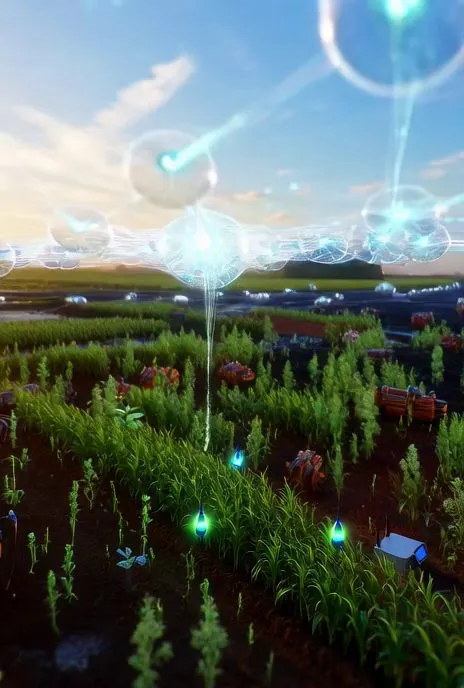
What is precision agriculture?
The International Society of Precision Agriculture defines it as a management strategy that gathers, processes and analyses temporal, spatial and individual plant and animal data and combines it with other information to support management decisions according to estimated variability, for improved resource use efficiency, productivity, quality, profitability and sustainability of agricultural production (ISPA, 2024).
In plain terms, no field is uniform. Soil depth, texture, slope, salinity and exposure vary from one corner to another, and so do crop needs. Precision agriculture measures that variability and adapts inputs, above all water and fertiliser, to it.
In North Africa, where water is the limiting factor, the most immediate application is precision irrigation: the right amount of water, at the right time, in the right place. In 2023, Tunisia's water stress level (SDG indicator 6.4.2) stood at about 97%, and agriculture accounted for 2.88 km³ of the 3.85 km³ of water withdrawn (FAO AQUASTAT).
Precision agriculture or smart farming: what is the difference?
The two terms overlap. Precision agriculture is about variability: measuring differences within a farm and managing them. Smart farming is broader: it covers the connected tools, automation and data platforms that make farm management more responsive, from a greenhouse climate controller to an alert on a phone.
In practice, a smart irrigation system becomes a precision agriculture tool when it adjusts water zone by zone according to measured soil moisture. A smart soilless greenhouse goes further still, since every input that reaches the plant is measured and controlled.
The distinction matters when you choose equipment. Ask what is measured, at what resolution and how often, and what the system does with the measurement. A tool that only displays data is a monitoring system; a tool that adjusts water or fertiliser zone by zone, from measured differences, is doing precision agriculture.
The building blocks: sensors, networks, data, AI and actuators
A precision agriculture system links measurement, decision and action. Each layer has its own role.
The value lies in the chain, not in any single component. A sensor without a decision rule produces numbers nobody reads; a connected valve without reliable measurement simply automates mistakes.
- IoT sensors: soil moisture probes, micro weather stations, flow and pressure meters, and pH and electrical conductivity (EC) probes for fertigation and soilless crops.
- Long-range, low-power networks such as LoRaWAN, which link field units spread over large areas, with the mobile network as a backup or gateway to the internet.
- Weather data: local measurements combined with forecasts to anticipate heat, wind or rain.
- Imagery: satellite or drone images that reveal differences in vigour between zones, useful for large plots and orchards.
- Software and artificial intelligence: dashboards, alerts, irrigation scheduling and anomaly detection, increasingly running on the device itself (edge AI).
- Actuators: connected solenoid valves, pumps and fertiliser dosing equipment that turn a decision into action.
What precision agriculture can deliver, and how to measure it
The expected benefits are easy to list: water and fertiliser used where they are needed, more uniform crops, fewer manual checks, early detection of leaks, and a written record of every operation. The ISPA definition itself names resource use efficiency, productivity, quality, profitability and sustainability as the goals (ISPA, 2024).
Measuring those gains is harder, and honesty matters. Results depend on the starting point: a farm that already irrigates carefully will save less than one that irrigates by habit. A credible evaluation compares the same plot, or a similar control plot, over a full season, with metered water, energy and yield.
- Water: metered volume per hectare or per tonne produced.
- Energy: pumping hours and electricity consumption.
- Yield and quality: weight and grade per zone.
- Labour: time spent checking and operating the network.
- Incidents: leaks and blockages detected, and how quickly they were fixed.
Costs and return on investment
Precision agriculture is not one product with one price. The cost depends on the farm's area and layout, the number of sensors and connected valves, the existing irrigation network, connectivity on site, software and the level of support. A first step on a single sector costs far less than equipping a whole farm.
Return on investment comes from savings in water, energy, fertiliser and labour, and from higher or steadier yields. It varies with the crop, the price of water and energy and the starting point, so we do not promise a payback period. A sensible approach is to start with the plots where water is most limiting or most expensive, measure the results over a season, then extend.
In Tunisia, the Agricultural Investment Promotion Agency (APIA) manages incentives for agricultural investment and the regional agricultural development offices (CRDA) support water-saving irrigation equipment. Check the current conditions at www.apia.com.tn and with your CRDA.
Barriers in Tunisia and North Africa, and how to overcome them
FAO's State of Food and Agriculture 2022, based on 27 case studies, identifies the key barriers to the adoption of digital automation technologies, particularly by small-scale producers: low digital literacy and the lack of enabling infrastructure such as connectivity and access to electricity, in addition to financial constraints (FAO, 2022). Each of them has practical answers.
- Connectivity: remote plots often have weak mobile coverage. Long-range radio such as LoRaWAN links field units to a single gateway, and local processing keeps the system running when the connection drops.
- Electricity: pumps and controllers need reliable power; solar supply and battery backup can be sized at the study stage.
- Skills: dashboards must be simple and alerts clear, and the farm team should be trained during installation, with remote support afterwards.
- Financing: start small, measure, then extend; use the support schemes available through APIA and the CRDA; agricultural development groups (GDA) can share the cost of common infrastructure.
Research: edge AI for irrigation networks
Research is moving intelligence closer to the field. HydroNeuro, work by Nasreddine Somaali, SESIT's founder, with the InnovCom laboratory at Sup'Com (University of Carthage), published in the journal Sensors in 2026, detects leaks and obstructions in irrigation networks in real time (Somaali et al., 2026).
The framework runs a lightweight neural network on an ESP32 microcontroller with TensorFlow Lite for Microcontrollers, and draws on hydraulic principles such as Bernoulli's equation and the Darcy–Weisbach formulation to structure the experiments and interpret pressure–flow relationships. On a laboratory-scale hydraulic test bench, it reports anomaly detection accuracy above 96% (Somaali et al., 2026). These are laboratory results; performance must be confirmed on real field networks.
Precision agriculture with SESIT: TELMA and AgroSelf
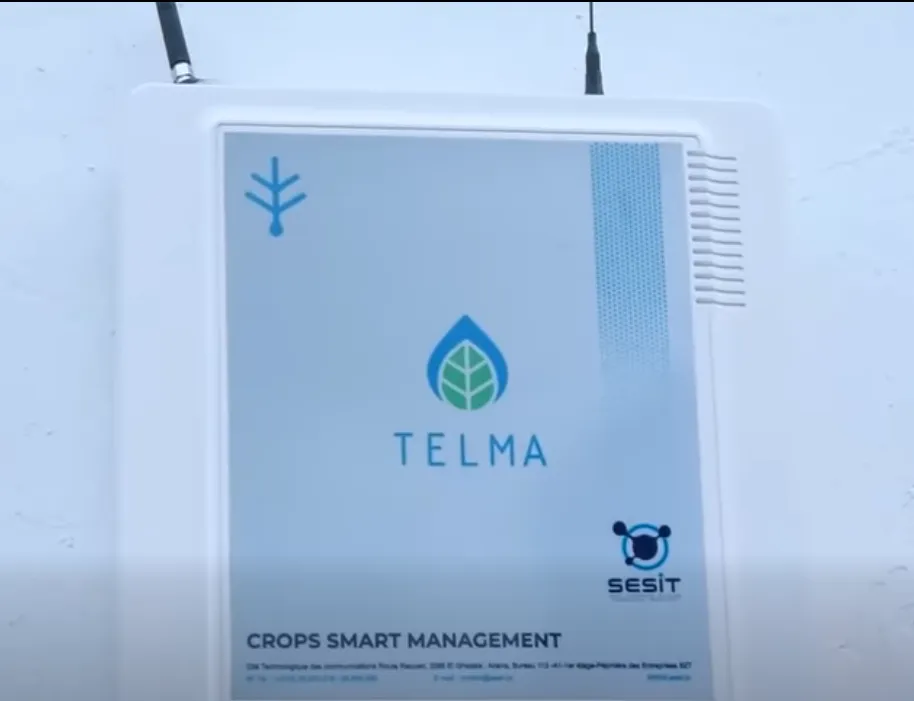
SESIT is a Tunisian agritech company with the Startup Act label, based in Raoued, Ariana. TELMA, its smart irrigation and fertigation system, applies precision agriculture to water: soil moisture sensors, micro weather stations and flow meters, connected field units over LoRaWAN with cellular fallback, smart valves operated zone by zone, fertiliser dosing into the irrigation water, and alerts for leaks and blockages.
For greenhouse crops, AgroSelf takes precision one step further with SESIT technology: the pH, EC and dissolved oxygen of the nutrient solution are tracked continuously and nutrients are dosed automatically, in a smart soilless greenhouse developed within a national research project with Sup'Com, INAT, ENIT and S2T.
In the field, SESIT technology is in service at the INAT soilless greenhouse in Tunis, near Sidi Thabet and, since September 2026, at the Nefta smart irrigation station in the south. A typical project follows four steps.
- Free study: site visit, water and soil, connectivity and power.
- Pilot on one or more sectors.
- Measurement of the results over a season.
- Extension to the rest of the farm, with training and ongoing support.
Frequently asked questions
Is precision agriculture only for large farms?
No. Large farms have more variability to manage, but a small or medium farm can start with one sector: a few soil moisture sensors, connected valves and alerts. Agricultural development groups (GDA) can also share infrastructure such as a gateway or a storage basin. The key is to start where water is most limiting.
What is the difference between precision agriculture and smart farming?
Precision agriculture measures variability within a farm and adapts inputs to it, zone by zone. Smart farming is the broader use of connected tools, automation and data. A smart irrigation system that adjusts water to measured soil moisture in each zone is both.
Do I need internet coverage on my farm?
Not everywhere. Long-range radio such as LoRaWAN links field units to a gateway, and only the gateway needs a mobile or internet connection. TELMA uses LoRaWAN with cellular fallback, and local processing keeps essential functions running if the connection drops.
Where should I start?
With a clear problem: the plot where water is scarcest or most expensive, a sector with uneven growth, or a network with frequent leaks. Install soil moisture sensors and flow measurement there, define simple rules, measure the results over a season, then extend. A free study helps to choose the right first step.
How much does it cost, and what is the return?
There is no single price: it depends on the area, the number of sensors and valves, the existing network and on-site connectivity and power. The return comes from savings in water, energy, fertiliser and labour, and from steadier yields. It varies with the starting point, which is why we recommend measuring a pilot before scaling up.
Is precision agriculture useful in hot, arid regions?
It is especially useful there, because water is the limiting factor. In Tunisia, agriculture accounted for 2.88 km³ of the 3.85 km³ of water withdrawn in 2023 (FAO AQUASTAT). Measuring soil moisture, detecting leaks and irrigating zone by zone directly target that resource.
Does artificial intelligence replace the agronomist?
No. AI helps to detect anomalies, forecast needs and automate routine decisions, but it applies a strategy; it does not define one. Water and soil analyses, crop choices and fertilisation programmes remain the agronomist's role, and the farmer keeps control at all times.
Is training included?
Yes. SESIT trains your team during installation on the dashboard, alerts and manual control, then provides technical support, remote diagnostics, on-site visits and preventive maintenance. FAO identifies low digital literacy as a key barrier to adoption, so training is part of every project (FAO, 2022).
Is there public support for precision agriculture in Tunisia?
There is support for agricultural investment and water-saving irrigation equipment through APIA and the regional CRDAs. Eligibility and rates change, so check them at www.apia.com.tn and with your CRDA. SESIT can provide the technical documents your application requires.
Sources
- International Society of Precision Agriculture (2024). Precision agriculture definition
- FAO (2022). The State of Food and Agriculture 2022: leveraging automation in agriculture for transforming agrifood systems
- FAO AQUASTAT. Country fact sheet: Tunisia (2023 data)
- Somaali N., Hayouni M., Sboui L. and Choubani F. (2026). HydroNeuro: a data-efficient IoT sensing and edge-AI framework for real-time hydraulic anomaly detection. Sensors, 26(10), 3010
- Shortridge J. and Porter W. (2021). Soil moisture sensors for agricultural irrigation: an overview on sensor types. Virginia Cooperative Extension, BSE-338P
Where should precision start on your farm?
Tell us about your plots, crops, water and connectivity. We will carry out a free study and suggest a first step whose results you can measure. WhatsApp: +216 55 879 318.