
 العربية
 Italiano
 Français
What is fertigation? Definition and principle
Fertigation, also called fertirrigation, is the practice of supplying crops with fertilisers through the irrigation water. Kafkafi and Tarchitzky describe it as a tool to give the plant its daily demand for water and nutrients according to its growth stage: a 'spoon-feeding' approach in which readily soluble nutrients reach the root volume directly (Kafkafi and Tarchitzky, 2011).
Fertigation works with any pressurised irrigation system, but its natural partner is drip irrigation. A dripper wets a limited volume of soil around the roots, so the nutrients dissolved in the water go exactly where the roots are active. In soilless greenhouses, fertigation is not an option but the rule: all of the nutrition arrives with the water (FAO, 2013).
Three basic requirements apply to every installation: injection equipment able to overcome the pressure in the line, a filter to stop solid particles from reaching the drippers, and a backflow-prevention valve to protect the water source (Kafkafi and Tarchitzky, 2011).
Why fertigate? What the research says
The main argument is efficiency. In fertigation, the timing, amount and concentration of the fertilisers applied are easily controlled, which raises fertiliser use efficiency, reduces the quantities applied and limits losses to groundwater (Kafkafi and Tarchitzky, 2011).
The same authors note that fertigation has allowed growers to farm sand dunes once classed as non-agricultural land, and see it as a way to turn desert soils into productive areas while saving water (Kafkafi and Tarchitzky, 2011). That makes it highly relevant to the oases and arid plains of North Africa, provided the water quality and the equipment are right.
The base is already there. In Tunisia, localised irrigation, mostly drip, covered about 241,000 hectares of the 451,500 hectares equipped for full-control irrigation in 2023 (FAO AQUASTAT). Each of those drip networks can, in principle, carry fertiliser as well as water.
- Nutrients delivered to the wetted root zone rather than spread over the whole field.
- Small, frequent doses adapted to each growth stage, from planting to harvest.
- Less fertiliser lost below the root zone, which protects aquifers, a key concern where groundwater supplies most of the water withdrawn, as in Tunisia (FAO AQUASTAT).
- Fewer tractor passes and less labour for spreading fertiliser.
Open field or soilless: two different uses of fertigation
In the open field, whether olive groves, date palms, citrus or vegetables on drip, the soil still stores part of the nutrients. Fertigation complements what the soil supplies: the grower adjusts nitrogen, phosphorus and potassium to the crop stage and to soil and leaf analyses, often with one or two fertiliser solutions and a moderate level of automation.
In soilless culture, the nutrient solution supplies everything. Each irrigation carries a complete solution, typically prepared from two stock tanks, tank A with calcium fertilisers and tank B with phosphate and sulphate fertilisers, plus a third tank of acid to control pH and keep the emitters clean (FAO, 2013). The grower also monitors the drainage: its volume and its EC show whether the crop is receiving too much or too little.
The logic is the same, but the precision required is not. Our smart hydroponics guide explains the soilless side in more detail.
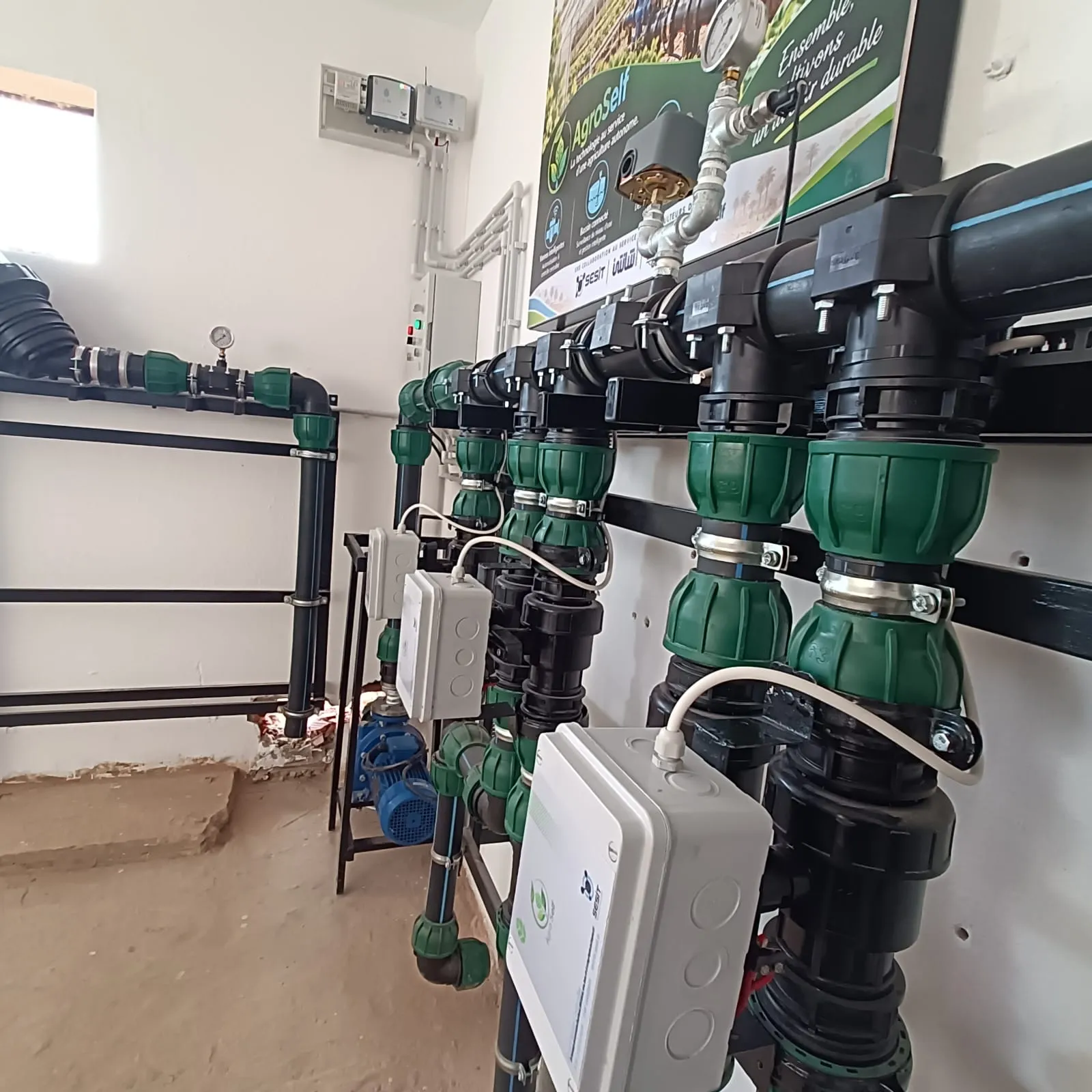
Fertigation equipment: venturi, proportional injector, dosing pump and A/B tanks
Injection equipment falls into a few families that differ in precision, cost and energy needs (Kafkafi and Tarchitzky, 2011).
There are also two ways of dosing: quantitative dosing, which injects a set amount of fertiliser at each irrigation, and proportional dosing, which keeps a constant ratio between fertiliser solution and water, and therefore a constant concentration (Kafkafi and Tarchitzky, 2011).
Why separate A and B tanks? When calcium is mixed in concentrated form with phosphates or sulphates, it forms calcium phosphate or calcium sulphate, which are only sparingly soluble: they settle in tanks and block drippers (FAO, 2013). Before using a new fertiliser, run a simple jar test: mix 50 ml of the fertiliser solution with one litre of your irrigation water and watch it for one to two hours. If the sample turns cloudy or forms a deposit, do not inject that product (Kafkafi and Tarchitzky, 2011).
Finally, the way the system is controlled matters as much as the injector. A simple timer applies a fixed programme; a conventional fertigation unit mixes to an EC and pH target; a connected system adds remote monitoring, records every application and alerts you when something drifts.
- Venturi injector: the flow of water through a constriction in the pipe creates suction that draws fertiliser solution from a tank. Simple, inexpensive and needs no electricity, but the injection rate varies with pressure and flow, and the device causes a pressure loss in the line.
- Fertiliser tank (differential pressure): part of the water passes through a sealed, pressurised tank. It can take solid fertilisers, but the concentration falls as the fertiliser dissolves, so the dose is uneven over the irrigation.
- Hydraulic proportional injector: driven by the water pressure, it injects at a set ratio to the flow and suits sites without electricity, but it discharges its driving water, about three times the volume of solution injected.
- Electric dosing pump: accurate, controllable and without pressure loss in the line; common in greenhouses where electricity is available and reliable.
- Complete fertigation unit: A and B stock tanks plus acid, filtration, solenoid valves and EC and pH sensors, managed by a controller that mixes and checks the solution before it reaches the crop.
Managing by EC and pH: benchmarks and limits
Electrical conductivity (EC) measures the total concentration of dissolved salts in the solution, meaning the fertilisers plus the salts already present in the water. pH governs nutrient availability and the risk of precipitates. Together, they are the two values a fertigation controller watches most closely.
Sensors are only as good as their maintenance. A drifting pH or EC probe will faithfully dose the wrong amount. Calibrate probes against reference solutions on a regular schedule, and check them whenever a reading looks surprising.
- pH: in fertigation, water is often acidified to limit scaling and keep the substrate pH in its optimal range, generally between 5.5 and 6.5 (FAO, 2013). The acids used, nitric, phosphoric or sulphuric, are also fertilisers, so their nutrient contribution must be counted.
- Alkalinity: it is the bicarbonate and carbonate content of the water, rather than its pH, that determines how much acid is needed (FAO, 2013). Hard, calcareous water is common across North Africa.
- EC target: it depends on the crop and the growth stage. Fruiting crops such as tomato are generally fed at a higher EC than leafy crops such as lettuce. Set targets with an agronomist, on the basis of a water analysis.
- Saline water: the EC of the raw water adds to that of the fertilisers, so the set point must take the starting water into account. Plant sensitivity to salinity varies between species and cultivars (Kafkafi and Tarchitzky, 2011).
From fertigation system to smart fertigation: what automation changes
Smart fertigation joins two layers: smart irrigation, which decides when and how much to water, and automated dosing, which decides what goes into that water.
Flow analysis is where much of the value lies: a sudden rise can mean a burst pipe, a slow decline can betray emitter clogging. Research by SESIT's founder, Nasreddine Somaali, with the InnovCom laboratory at Sup'Com (University of Carthage), published in the journal Sensors in 2026 under the name HydroNeuro (doi:10.3390/s26103010), explores real-time detection of such hydraulic anomalies on a microcontroller. Its results so far come from a laboratory test bench.
What automation does not do: it does not replace a water analysis, a soil analysis or agronomic advice. It applies a strategy faithfully; it does not invent one.
- Set points per crop and per growth stage, changed in a few clicks rather than by re-mixing tanks.
- Dosing proportional to the measured flow, so the concentration stays steady when pressure varies.
- Soil moisture sensors that trigger irrigation when the soil falls below a threshold. They must be installed in undisturbed soil, and dielectric sensors need a soil-specific calibration (Shortridge and Porter, 2021).
- A record of every irrigation and every dose, useful for traceability and for refining the programme season after season.
- Alerts for pH or EC drift, an empty tank, abnormal flow, a leak or a blocked line, sent to the grower's phone.
- Remote monitoring and control, with the option of taking back manual control at any time.
Common fertigation mistakes in hot, dry regions
Emitter clogging, which affects both the application rate and the uniformity of watering, is one of the greatest problems in drip irrigation; physical, chemical and biological substances in the water are its main causes (Kafkafi and Tarchitzky, 2011). Most problems trace back to a handful of avoidable errors.
When chemical deposits have already formed, flushing the system with acid, nitric acid for instance, can dissolve them and restore flow, with strict safety precautions (Kafkafi and Tarchitzky, 2011). Iron in well water is another hidden risk: ferrous iron concentrations as low as 0.15–0.22 g per cubic metre are considered potentially hazardous to drip systems (Kafkafi and Tarchitzky, 2011).
- Ignoring water hardness: calcium-rich, alkaline water precipitates calcium carbonate, and phosphate fertilisers increase the risk (Kafkafi and Tarchitzky, 2011).
- Mixing incompatible products in a single tank, especially calcium with phosphates or sulphates.
- Using fertilisers that are not fully soluble or not pure enough for fertigation.
- Overdosing, which builds up salts in the root zone, especially with saline water and high evaporation.
- Not flushing the lines with clean water at the end of each fertigation.
- Insufficient filtration, or filters that are not cleaned often enough.
- Uncalibrated pH and EC probes, and no backflow prevention on the water source.
Cost, public support and TELMA, SESIT's smart fertigation solution
The cost of a fertigation system depends on the number of irrigation sectors, the number of fertiliser solutions, the level of automation, the filtration and any water treatment. A venturi on a small plot and a fully monitored unit for a multi-sector greenhouse are very different investments, so we quote only after studying your water, your crops and your existing network.
In Tunisia, the Agricultural Investment Promotion Agency (APIA) manages incentives for agricultural investment under Investment Law No. 2016-71, and the regional agricultural development offices (CRDA) support water-saving irrigation equipment. Check the current conditions at www.apia.com.tn and with your CRDA; we do not quote rates that may have changed.
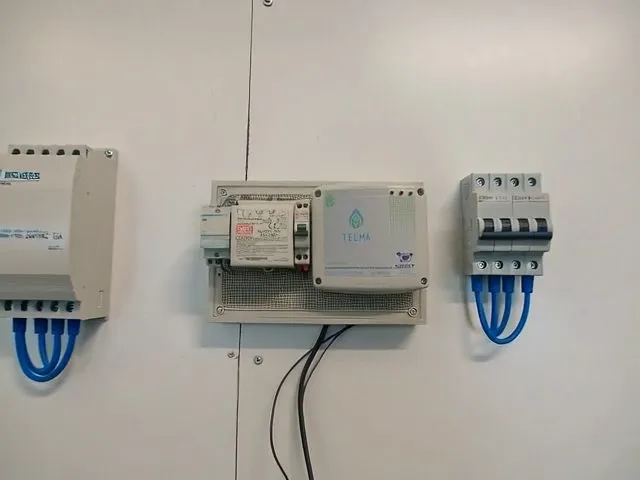
SESIT is a Tunisian agritech company with the Startup Act label. TELMA, its smart irrigation and fertigation system, controls irrigation zone by zone with soil moisture sensors, smart valves and remote control, doses fertiliser into the irrigation water, and detects leaks and blockages. SESIT reports that TELMA can save up to 30% of water, raise yields by up to 20% and cut costs by up to 25%; actual results depend on the site, the crop and the starting point, so each project is sized after a study of your water, your crops and your existing equipment. For soilless greenhouses, AgroSelf monitors pH and EC and doses the nutrient solution automatically, using SESIT technology.
In September 2026, in the Nefta oasis (Tozeur region), we commissioned our first reference site in southern Tunisia together with a local agricultural development group: an irrigation station with smart valves, a connected basin and real-time monitoring, so that irrigation is controlled automatically and remotely.
Frequently asked questions
Is there a difference between fertigation and fertirrigation?
No. Both words describe the same practice: applying fertilisers dissolved in the irrigation water, usually through drip irrigation. 'Fertigation' is more common in English, while 'fertirrigation' is closer to the French, Italian and Spanish terms. 'Smart fertigation' adds sensors and a controller that adjust the dose and send alerts.
How much does a fertigation system cost?
It depends on the number of irrigation sectors, the number of fertiliser solutions, the injection method, the filtration, any water treatment and the level of automation. A venturi injector for a small plot and a multi-tank unit with EC and pH control for a greenhouse are very different budgets. We quote after studying your water analysis, your crops and your current network.
Venturi, proportional injector or dosing pump: which should I choose?
A venturi is cheap and needs no electricity, but its injection rate varies with pressure and it causes a pressure loss. A hydraulic proportional injector keeps a steady ratio without electricity but discharges driving water. An electric dosing pump is the most precise and easiest to automate, provided the power supply is reliable (Kafkafi and Tarchitzky, 2011). The right choice depends on your area, crop and power supply.
Can olive trees or date palms be fertigated by drip irrigation?
Yes. Drip irrigation is widely used in olive groves and date palm oases, and the same network can carry fertiliser. For perennial crops, doses are split over the season according to the growth stage, and adjusted with soil and leaf analyses. Good filtration and a water analysis are essential, because hard or saline water is common in many North African oases.
Which fertilisers can be used in fertigation?
Use fertilisers that are fully soluble, of high purity, low in salt and with an acceptable pH (Kafkafi and Tarchitzky, 2011). Check compatibility: keep calcium fertilisers in one tank and phosphates and sulphates in another. Before using a new product, mix 50 ml of solution with one litre of your irrigation water; if it turns cloudy within one to two hours, do not inject it.
How can I prevent drippers from clogging?
Start with a water analysis covering hardness, iron and suspended solids. Install suitable filtration and clean it regularly, keep incompatible fertilisers apart, acidify where the water is alkaline and flush the lines with clean water after each fertigation. Monitoring the flow in each sector also helps: a gradual drop is often the first sign of clogging, long before plants show stress.
My water is saline: is fertigation still possible?
Usually, yes, but the plan must start from the water. The EC of the raw water adds to that of the fertilisers, so the target EC has to account for the salts already present, and some leaching may be needed to keep salts from building up in the root zone. Crop sensitivity to salinity varies between species and cultivars. In some cases, blending or desalinating the water is worth studying.
Can an existing drip system be automated?
In many cases, yes. TELMA is designed to control irrigation and fertigation on existing networks, with soil moisture sensors, smart valves, fertiliser dosing into the irrigation water and remote control. What can be reused depends on your injection equipment, filtration and water. The site study checks the condition of the network, the pressure and the sectors before anything is installed.
How much water can smart irrigation save?
There is no universal figure: savings depend on your starting point, your soil, your crop and your climate. Moving from flood to drip irrigation, then scheduling irrigation with soil moisture sensors rather than by habit, both reduce over-watering (Shortridge and Porter, 2021). For TELMA, SESIT reports up to 30% water saved, alongside up to 20% higher yield and up to 25% lower costs; we measure consumption site by site.
Do I need training to run a smart fertigation system, and what support is available?
Basic training is essential: your team must understand EC, pH, tank preparation, filter cleaning and how to take back manual control. SESIT trains users during installation, then provides technical support, remote diagnostics, on-site visits, preventive maintenance and software updates. Agronomic advice on fertiliser programmes remains the role of your agronomist or extension service.
Sources
- Kafkafi U. and Tarchitzky J. (2011). Fertigation: a tool for efficient fertilizer and water management. IFA and IPI
- FAO (2013). Good Agricultural Practices for greenhouse vegetable crops: principles for Mediterranean climate areas. Plant Production and Protection Paper 217
- Shortridge J. and Porter W. (2021). Soil moisture sensors for agricultural irrigation: an overview on sensor types. Virginia Cooperative Extension, BSE-338P
- FAO AQUASTAT. Country fact sheet: Tunisia (2023 data)
Ready to fertigate more precisely?
Send us your water analysis, your crops and a description of your current drip network. We will study your project and propose the right TELMA configuration for smart irrigation and fertigation. WhatsApp: +216 55 879 318.