
 العربية
 Italiano
 Français
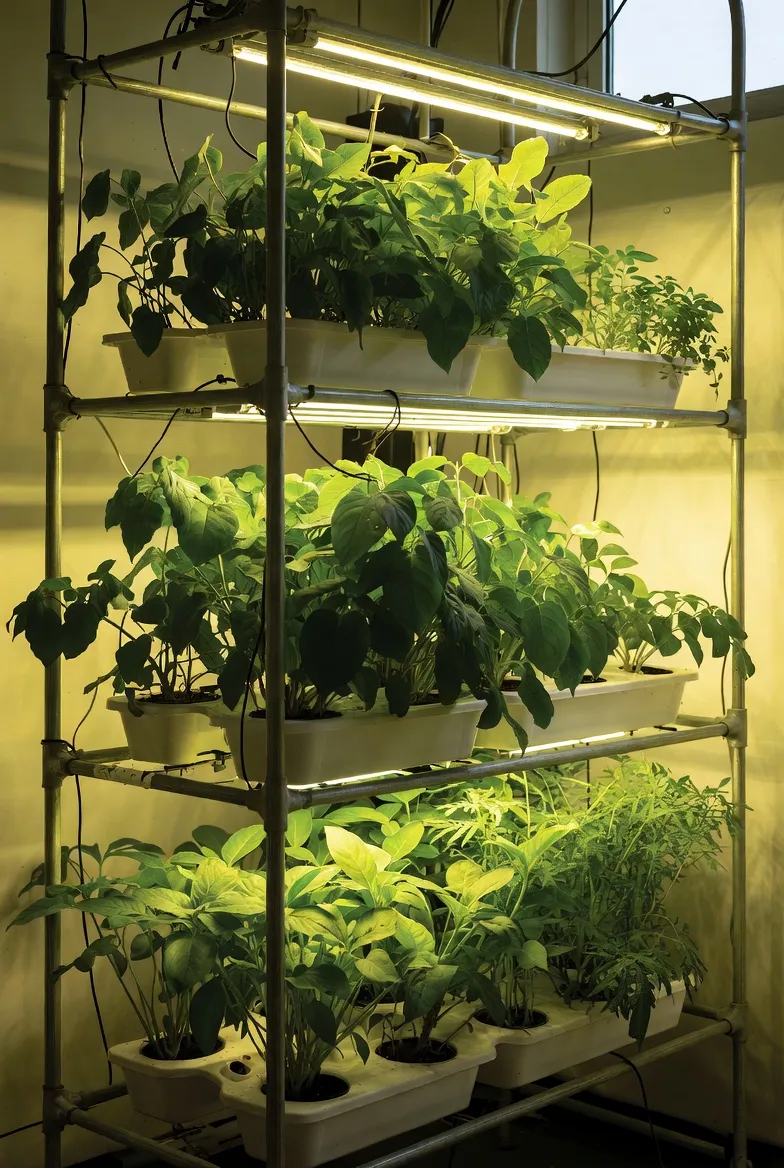
Hydroponics, soilless growing and aquaponics: what is the difference?
Soilless growing, or soilless culture, is the umbrella term for any production method in which plant roots do not grow in natural soil. The FAO reference manual on greenhouse vegetables for Mediterranean climates classifies soilless systems by the way plants are supported: substrate culture, in which roots grow in a mineral or organic medium such as rockwool, perlite or coco coir, and water culture, or hydroponics in the strict sense, in which roots are partly or fully immersed in the nutrient solution (FAO, 2013).
In everyday language, 'hydroponics' often covers both. What they share is that every nutrient the plant needs is dissolved in the irrigation water: in all modern soilless systems, irrigation and fertilisation are merged into a single operation, fertigation (FAO, 2013). Aquaponics is a related approach that couples fish farming with plant production, using the nutrients released by the fish; it follows its own biological rules and is not covered in detail here.
A second distinction matters just as much: open loop or closed loop. In an open-loop system, the drainage solution leaves the system. In a closed-loop system, it is collected, corrected and recirculated. As we will see, this choice largely determines how much water and fertiliser a hydroponic greenhouse really saves.
What makes hydroponics 'smart': sensors, controller and alerts
A hydroponic system becomes smart when it no longer depends on occasional manual checks. Sensors take continuous readings, a controller compares them with set points defined for the crop and its growth stage, and actuators such as dosing pumps, valves, fans and shade screens correct any drift. The grower follows everything on a dashboard or a phone and receives an alert when something goes wrong.
Why does this matter? Closed-loop systems need more precise and frequent control of the nutrient solution, call for technical know-how and are more sensitive to operating mistakes, notably in spring, when rising temperature and solar radiation can push nutrient concentrations up (FAO, 2013). Automation does not remove the need for agronomic judgement, but it catches drifts that a weekly hand-held reading would miss.
Data also builds up over time. Logged readings help to spot a failing pump, a probe that needs recalibrating or a gradual rise in salinity before the crop shows symptoms. The grower stays in charge: any automatic action can be overridden by hand at any time.
- Nutrient solution: pH, electrical conductivity (EC), solution temperature and dissolved oxygen.
- Water and tanks: tank levels, flow rates, pump status and drainage volume.
- Greenhouse climate: air temperature, humidity, light and CO₂.
- The control loop: measure, compare with the set point, dose acid or A and B stock solutions, recirculate, then alert.
NFT, deep water culture, Dutch bucket or substrate: which system should you choose?
There is no single best hydroponic system. The right choice depends on the crop, the climate, the reliability of the power supply and the skills of the team. The main options compare as follows.
As a rule of thumb, the less water a system holds around the roots, the faster it reacts to a power cut or a heatwave. For leafy greens, NFT or floating rafts are efficient; for fruiting crops grown over several months, substrate or Dutch bucket systems are generally more forgiving.
- Nutrient film technique (NFT): a film of solution 1–2 mm deep flows along channels sloped at 1.2–3%. It needs little solution, which saves water and fertiliser, but it has very little buffer if the supply stops and works best for short crops of 30–50 days such as lettuce (FAO, 2013).
- Deep water culture (DWC) and floating rafts: plants sit on trays floating on 0.20–0.30 m of solution, or 150–250 litres per square metre. The large volume buffers temperature and reduces how often the solution must be adjusted; dissolved oxygen should stay between 5 and 6 mg per litre (FAO, 2013). Well suited to lettuce, baby leaf and herbs such as basil.
- Deep flow technique (DFT): a continuously flowing solution 50–150 mm deep, which simplifies nutrient control and buffers temperature (FAO, 2013).
- Dutch bucket: individual containers filled with a coarse medium such as perlite, with the drainage collected and returned. Used for long, trained crops such as tomato, cucumber and sweet pepper.
- Substrate in bags or slabs (coco coir, perlite, rockwool): widely used in commercial soilless greenhouses for tomato, pepper, cucumber and strawberry, with the substrate acting as a moisture buffer between irrigations.
How much water does hydroponics really save?
Water savings depend first on recirculation. An open-loop system that discards its drainage saves less than a closed loop that recovers, corrects and reuses it. FAO notes that closed systems give the lowest environmental impact, yet cannot eliminate fertiliser runoff entirely, since the exhausted solution still has to be collected and treated at the end of the crop cycle (FAO, 2013).
One widely cited study modelled lettuce grown in a hypothetical 815 m² hydroponic greenhouse in Yuma, Arizona, and compared it with conventional field production in the same area. It estimated water use at about 20 ± 3.8 litres per kilogram for hydroponics against 250 ± 25 litres per kilogram in the field, with yields of 41 ± 6.1 kg/m² per year against 3.9 ± 0.21 kg/m² (Barbosa et al., 2015).
The same study shows the other side of the coin. Energy use reached about 90,000 kJ per kilogram against 1,100 kJ, dominated by heating and cooling loads, and the authors concluded that, given this energy demand, commercial hydroponics was not a suitable alternative for lettuce in Yuma. The lesson for hot regions is clear: the water gains are real, but the cooling strategy must be designed as carefully as the hydroponic system itself.
Why it matters in North Africa: according to FAO AQUASTAT, Tunisia withdrew 3.85 km³ of water in 2023, 2.88 km³ of it for agriculture, and its water stress level (SDG indicator 6.4.2) stood at about 97% (FAO AQUASTAT). At SESIT, we measure the water consumption of our installations and will publish those measurements site by site.
Smart hydroponics in hot, arid climates: heat, brackish water and power cuts
This is where projects in Tunisia, the Gulf or the Sahel succeed or fail. Three constraints deserve attention from the very first sketch.
In southern Tunisia, around Tozeur, Kebili or Gabès, these three constraints often come together. They do not rule out hydroponics, but they shape the design: system type, tank volume, cooling, water treatment and backup power. Our smart fertigation guide explains how to set nutrient targets when the irrigation water is already saline.
- Summer heat: a warm nutrient solution holds less dissolved oxygen, and roots suffer. Shade the greenhouse, use evaporative pad-and-fan cooling, bury or insulate tanks and favour systems with a larger solution volume. For NFT, FAO recommends covering channels with white-on-black film, white side out, to reflect light and avoid overheating the roots and the solution (FAO, 2013).
- Brackish water: analyse the water before anything else, including EC, sodium, chloride and bicarbonates. Salts already in the water reduce the margin left for fertilisers. In closed loops, sodium and chloride build up over time; the standard practice is to suspend recycling temporarily and discharge the drainage until its EC returns to an acceptable level (FAO, 2013). Reverse osmosis may be justified, depending on the water and the crop.
- Power and network cuts: an NFT channel can dry out quickly if the pump stops. Plan battery or UPS backup for pumps and controllers, choose a system with a larger buffer where outages are frequent, and make sure alerts reach the grower over the mobile network as well as the internet.
Which crops suit a smart hydroponic greenhouse?
Most vegetables can technically be grown without soil. Commercial soilless production concentrates on crops with a high value per square metre and a steady market.
Yields depend on climate, variety, cycle length and management. Treat any yield figure that is not tied to a specific site, crop and season with caution: the study cited above, for example, models lettuce yields for one location in Arizona, not for a greenhouse near Sfax or Agadir. We do not promise yields; we help you set realistic targets for your site.
- Leafy greens and herbs: lettuce, baby leaf, rocket, basil and mint. Short cycles, well suited to NFT and floating systems (FAO, 2013).
- Fruiting vegetables: tomato, including the cherry tomato grown in greenhouses in southern Tunisia, as well as cucumber, sweet pepper and melon, usually on substrate or in Dutch buckets.
- Strawberry, often grown in raised troughs or bags to make picking easier.
- Hydroponic fodder, such as sprouted barley for livestock, is a separate technique with its own economics and is not covered in this guide.
What does a smart hydroponic greenhouse cost, and is it profitable?
We do not publish a standard price, because two projects of the same size can differ widely. These are the main cost drivers.
FAO identifies high installation costs and the need for technical skills as the main obstacles to soilless culture. In simple greenhouses that rely on mild winters and strong sunshine, the extra investment is usually justified only when soil problems become critical, water is scarce or nutrient leaching is a serious issue (FAO, 2013). In other words, profitability comes from the market, meaning selling price, outlets and export standards, as much as from the technology.
In Tunisia, incentives for agricultural investment are managed by the Agricultural Investment Promotion Agency (APIA) under Investment Law No. 2016-71 of 30 September 2016, and the regional agricultural development offices (CRDA) support water-saving irrigation equipment. Conditions change, so check the current rules at www.apia.com.tn and with your CRDA before building your financing plan.
- Surface area and greenhouse structure, from tunnel to multi-span.
- The soilless system itself: channels, rafts, gutters, substrate, tanks and pumps.
- Cooling or heating, which in hot climates can outweigh every other item.
- Automation: sensors, dosing pumps, connected controllers and software.
- Water treatment (filtration, disinfection, reverse osmosis where needed) and energy, including backup power.
- Labour, training and technical follow-up.
How SESIT supports a smart hydroponic project
SESIT is a Tunisian agritech company with the Startup Act label, based in Raoued, Ariana, near Tunis. At the heart of AgroSelf, a smart soilless farming solution, is SESIT technology: sensors, connected controllers and a control platform that monitor pH, EC and dissolved oxygen, automate nutrient dosing and recirculation, and manage the greenhouse climate.
AgroSelf is being developed within a national research project funded by the Tunisian Ministry of Higher Education and Scientific Research, with Sup'Com, INAT, ENIT and S2T, and is deployed in the INAT soilless greenhouse in Tunis. It was presented at the ICCSIC international conference in Tabarka in March 2026 and at Agrinnov in Hammamet in April 2026.
A typical project follows these steps.
- Discussion and site visit, to understand your crops, your market and your constraints.
- Analysis of the water and the site.
- System sizing: soilless method, tanks, cooling, sensors and backup power.
- Installation of sensors, controllers and dosing equipment, then configuration of the set points.
- Training of your team, followed by maintenance, remote diagnostics and technical support.
Frequently asked questions
How much does a hydroponic greenhouse cost in Tunisia or North Africa?
There is no standard price. The budget depends on the surface area, the greenhouse structure, the soilless system, cooling, the level of automation, water treatment and energy. Cooling and water treatment in particular vary a great deal from one site to another. We prepare a quote after analysing your water and visiting your site, so that every item is sized for your conditions rather than taken from a catalogue.
What equipment do I need to start smart hydroponics?
A greenhouse with shading and cooling suited to your climate; a growing system (NFT channels, rafts, buckets or substrate); a mixing tank, A and B stock tanks and an acid tank; pumps and filtration; dosing pumps or injectors; pH, EC and temperature sensors; a controller with alerts; and backup power for the pumps. A water analysis comes before any purchase.
Is hydroponics profitable?
It can be, but no one can honestly promise a return in advance. Profitability depends on the crop, the selling price, access to markets, and the cost of water and energy. FAO notes that the extra investment is easiest to justify where soil problems are severe, water is scarce or nutrient leaching is a concern. A sound project starts from a market and a realistic yield target, not from the equipment.
How much water does a hydroponic crop use?
It depends mostly on whether the drainage is recirculated. In a modelled lettuce greenhouse in Arizona, researchers estimated about 20 litres per kilogram in hydroponics against about 250 litres per kilogram in the field, while warning that energy use for cooling and heating was far higher (Barbosa et al., 2015). Results for your crop and climate will differ, which is why we measure consumption site by site.
Can hydroponics work in very hot, arid regions such as southern Tunisia or the Gulf?
Yes, provided the heat is built into the design from the start. Shade, evaporative cooling, buried or insulated tanks and systems with a larger solution volume keep the root zone cool and oxygenated. Energy for cooling is often the largest running cost, so it must be estimated at the study stage, along with water quality and the reliability of the power supply.
Can I use brackish or saline water for hydroponics?
Often, yes, but analyse the water first. The salts already present raise the EC and leave less room for fertilisers, and in closed loops sodium and chloride accumulate, so the drainage must be discharged from time to time (FAO, 2013). Plant sensitivity to salinity varies between species and cultivars (Kafkafi and Tarchitzky, 2011). Depending on the results, reverse osmosis or a more tolerant crop may be the right answer.
What happens during a power cut or an internet outage?
In an NFT system the roots can dry out quickly if the pump stops, so backup power for pumps and controllers is essential where outages are common. Systems with a larger volume of solution, such as rafts or substrate, buy time. Alerts should also reach the grower over the mobile network. During the study, we define with you how the installation behaves and who is alerted if power or connectivity is lost.
Do I need training to run a smart hydroponic greenhouse?
Yes. Automation reduces routine checks, but the team must understand pH, EC, hygiene and crop management, and know how to take back manual control. SESIT trains your team during installation and then provides technical support, remote diagnostics, on-site visits and maintenance. Agricultural training centres and extension services are useful complements for agronomy.
Can hydroponic vegetables be sold as organic?
Not in the European Union: Regulation (EU) 2018/848 states that hydroponic production should not be allowed in organic farming, because organic plants must grow in living soil. Other markets set their own rules, so check the organic standard of the country where you sell, including Tunisia's national specifications. Hydroponic produce can still compete on quality, freshness and traceability.
Is there public support for hydroponic projects in Tunisia?
Agricultural investment incentives are managed by the Agricultural Investment Promotion Agency (APIA) under Investment Law No. 2016-71, and the regional agricultural development offices (CRDA) support water-saving irrigation equipment. Eligibility and rates change over time, so consult www.apia.com.tn and your CRDA directly. We can provide the technical documents your application requires.
Sources
- FAO (2013). Good Agricultural Practices for greenhouse vegetable crops: principles for Mediterranean climate areas. Plant Production and Protection Paper 217
- Barbosa G. L. et al. (2015). Comparison of land, water, and energy requirements of lettuce grown using hydroponic vs. conventional agricultural methods. International Journal of Environmental Research and Public Health, 12(6)
- FAO AQUASTAT. Country fact sheet: Tunisia (2023 data)
- Kafkafi U. and Tarchitzky J. (2011). Fertigation: a tool for efficient fertilizer and water management. IFA and IPI
- Regulation (EU) 2018/848 on organic production and labelling of organic products, recital 28
Planning a smart hydroponic greenhouse?
Tell us about your site, your water and your crops. We will study your project, from water analysis to sizing and automation, and come back with a clear proposal. You can also reach us on WhatsApp at +216 55 879 318.